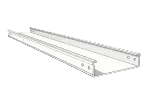
cable tray
Formed via integrated stamping; ensures balanced heat dissipation and temperature control; features drainage holes to prevent water accumulation and resist moisture-induced corrosion.
 [language-switcher]

 September 02, 2026
Industrial facilities depend on extensive networks of power, control, communication and data cables. If these cables are routed without a coordinated support system, future expansion becomes difficult, maintenance takes longer and cables may face unnecessary mechanical or environmental risks.
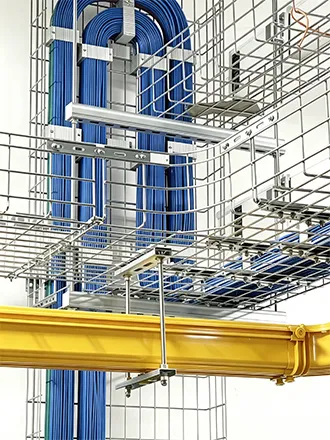
An industrial cable tray system creates an organized pathway for supporting and routing cables throughout a facility. Depending on the cable type and operating environment, the system may use ladder cable trays, perforated cable trays, trough-type trays, wire mesh trays or other project-specific configurations.
Shandong Hongfeng Power Technology Co., Ltd. manufactures cable tray products in different materials, specifications and surface finishes. With multiple forming, accessory-processing, spray-coating and welding lines, Hongfeng supports industrial projects that require coordinated straight sections, fittings, supports and customized cable-routing solutions.
Cable management is not simply a matter of keeping electrical wiring neat. It directly affects installation efficiency, maintenance accessibility, future expansion and the reliability of the overall cable route.
Industrial facilities commonly contain several cable groups, including:
These cables may need different routing, separation and protection arrangements. A properly designed industrial cable tray system helps organize the routes while keeping cables accessible for inspection, replacement and future additions.
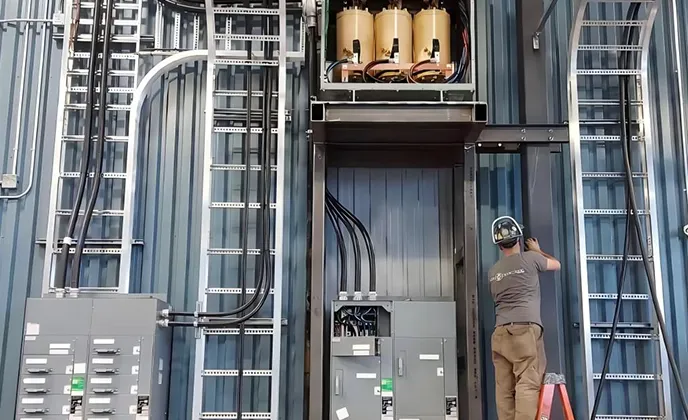
A correctly selected industrial cable tray provides practical benefits throughout the installation’s service life.
Cable trays provide defined routes for electrical and communication cables. This makes the system easier to coordinate with machinery, structural components, ventilation ducts, fire-protection systems and other building services.
Different cable groups can be installed in separate trays or divided within the same system when the project design permits.
Compared with routing every cable through an individual enclosed pathway, an open or accessible cable tray can simplify installation and later modifications.
Maintenance teams can visually inspect the cable route, locate damaged components and add or replace cables without dismantling large sections of the system. The actual installation method must still follow approved drawings and applicable electrical requirements.
Factories and industrial facilities often expand production lines, replace machinery or add automation equipment. These changes can require additional power, control and data cables.
A cable tray system can support future expansion when adequate usable space, load capacity and structural support have been reserved during the initial design.
Industrial buildings rarely have completely straight cable routes. Cables may need to pass around columns, change elevation, branch toward equipment or connect different production areas.
A complete tray system can include:
Hongfeng operates four semi-automatic accessory-processing lines that support the production of elbows, fittings and smaller-volume customized components.
Using compatible straight sections, fittings and supports helps create a consistent cable-management system.
Dimensions, materials, finishes and connection methods should be coordinated at the quotation stage. This reduces the risk of receiving accessories that do not match the selected tray profile or installation conditions.
Industrial cable trays may be manufactured from different metals and supplied with different protective finishes. Selection should be based on the real exposure conditions rather than price alone.
Galvanized steel is commonly used for indoor facilities and other environments with moderate corrosion exposure.
Buyers should confirm the galvanizing process, coating requirements, material thickness and treatment of cut or welded areas.
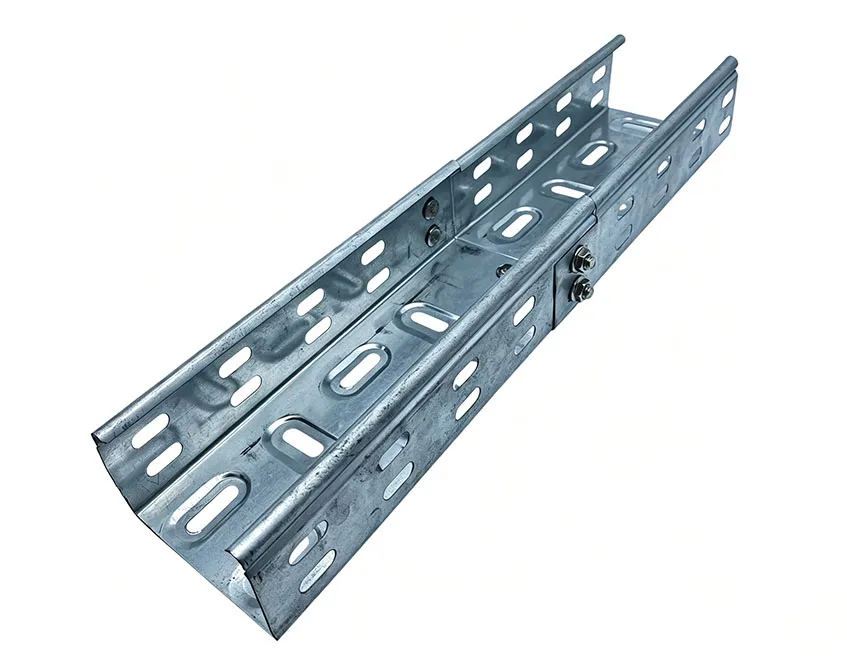
Hot-dip galvanizing is frequently considered for outdoor, humid and industrial environments requiring stronger corrosion protection.
Coating specifications should be defined clearly because the term “hot-dip galvanized” does not by itself provide all the information needed for engineering approval.
Powder coating can provide a protective and decorative surface in specified colors. It is often selected where appearance, project identification or an additional protective finish is important.
Hongfeng operates automatic spray-coating lines that support different cable tray surface-treatment requirements. Coating type, color, thickness and application environment should be confirmed before production.
Stainless steel can be considered for corrosive, hygienic or demanding industrial environments.
The stainless steel grade must be specified because resistance to chemicals, moisture and chlorides varies between grades.
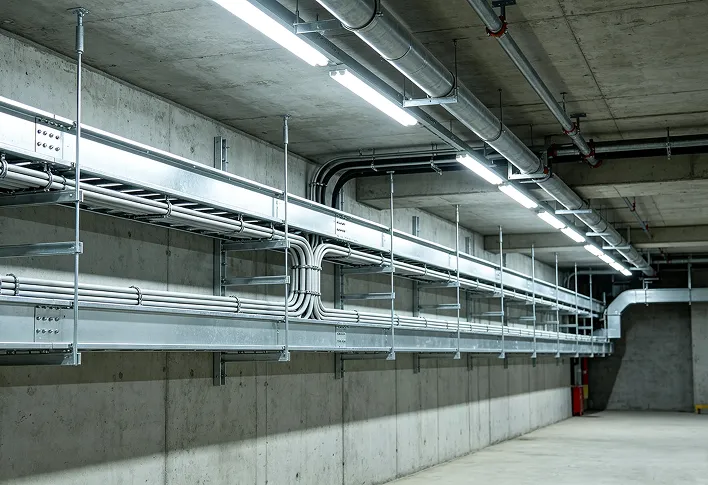
Hongfeng cable tray products can support cable-routing requirements across a broad range of projects.
Manufacturing facilities require cable routes for production machinery, control cabinets, automated equipment, lighting and utility systems.
Cable tray layouts should provide access for maintenance while avoiding interference with moving equipment and material-handling routes.
Petroleum and chemical environments may expose cable systems to corrosive substances, humidity and demanding operating conditions.
Material, coating, grounding, cable separation and fire-related requirements must be reviewed according to the project specification.
Power plants, substations and other energy facilities contain substantial power, control and instrumentation cable networks.
Ladder trays, perforated trays and other configurations may be used in different areas depending on cable weight, routing and protection requirements.
Metallurgical plants and heavy manufacturing facilities may involve heat, dust, vibration and substantial cable loads.
Tray structure, support design and corrosion protection should be selected for the specific operating area rather than applying one specification throughout the facility.
Shandong Hongfeng Power Technology Co., Ltd. is a cable tray production and processing enterprise located in Liaocheng, Shandong Province.
The company’s documented production capabilities include:
These facilities support both standard products and customized project requirements.
Hongfeng applies quality control from raw-material sourcing through manufacturing and final-product inspection.
The company’s submitted qualifications include:
For project approval, buyers should request the relevant documentation and verify that the certificate or test scope applies to the ordered product.
According to the company’s current published information:
Actual delivery time depends on specification, quantity, surface treatment, documentation and current production scheduling. It should be reconfirmed when the order is placed.
Hongfeng provides support from technical consultation and solution customization to order production and after-sales service.
For a more accurate recommendation, buyers should provide cable schedules, route drawings, environmental conditions, material requirements and required fittings when requesting a quotation.
There is no single tray type suitable for every industrial facility. Selection depends on cable type, cable weight, required protection, installation environment, support span and maintenance needs.
Yes. Hongfeng can manufacture cable trays in different materials, specifications and surface finishes. Customized fittings and accessories can also be evaluated according to project drawings.
Ladder cable trays are commonly considered for larger cable bundles and heavier power cables. However, tray construction and load capacity must be verified for the actual cable weight and support span.
They can be used in corrosive environments when an appropriate material and surface treatment are selected. Chemical exposure, humidity, salt spray and required service conditions should be provided before selection.
Compatible covers and dividers can be supplied for selected systems. Covers provide additional physical protection, while dividers help separate different cable groups. Exact compatibility should be confirmed with the tray specification.
Load capacity should be confirmed using product-specific technical data based on tray width, side height, material, thickness, rung spacing and support span. A general description such as “heavy-duty” is not sufficient.
We will reply you within 24 hours. If for urgent case, please add WhatsApp/WeChat:+86 188 6519 8768, Or call +86 188 6519 8768 directly.
We respect your confidentiality and all information are protected.
We will only use your information to respond to your inquiry and will never send unsolicited emails or promotional messages.
 Inquiry